

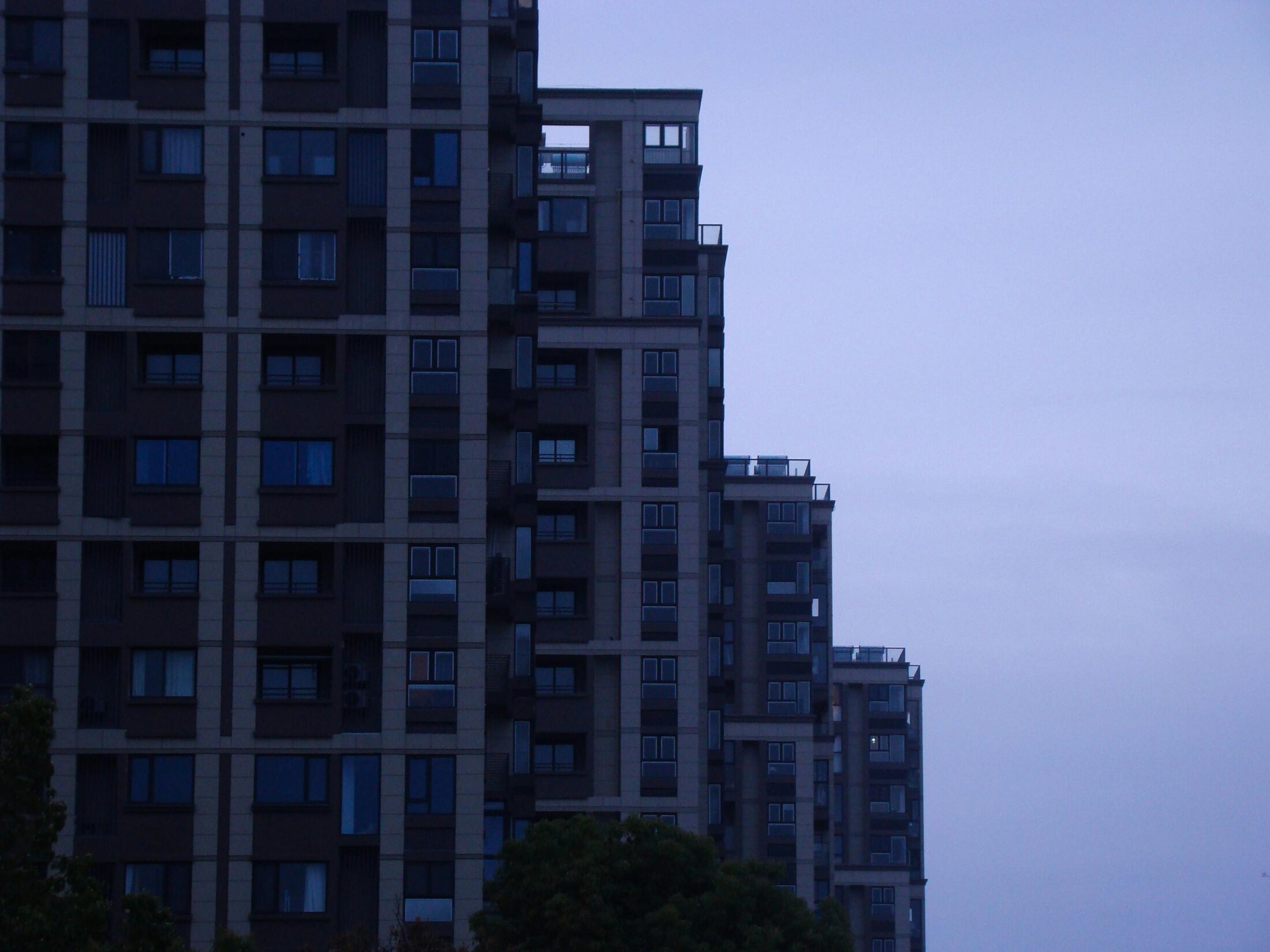
If you’ve driven through Downtown San Mateo lately, you’ve probably noticed the quiet floors and darkened windows in older office buildings that once buzzed with weekday traffic.
Remote and hybrid work didn’t just change where people log in—it fundamentally reshaped demand across the Peninsula. What was once theoretical is now very real: cities like San Mateo are actively rethinking how underused commercial space can help solve an ongoing housing shortage.
Increasingly, the conversation is centered on the San Mateo office to residential conversion as a practical, policy-backed path forward. Developers, planners, and long-time locals are all watching these shifts closely.
With state housing mandates tightening and land scarcity limiting new ground-up projects, adaptive reuse has gone from a niche idea to a core strategy.
Will San Mateo Turn Empty Offices into Housing?
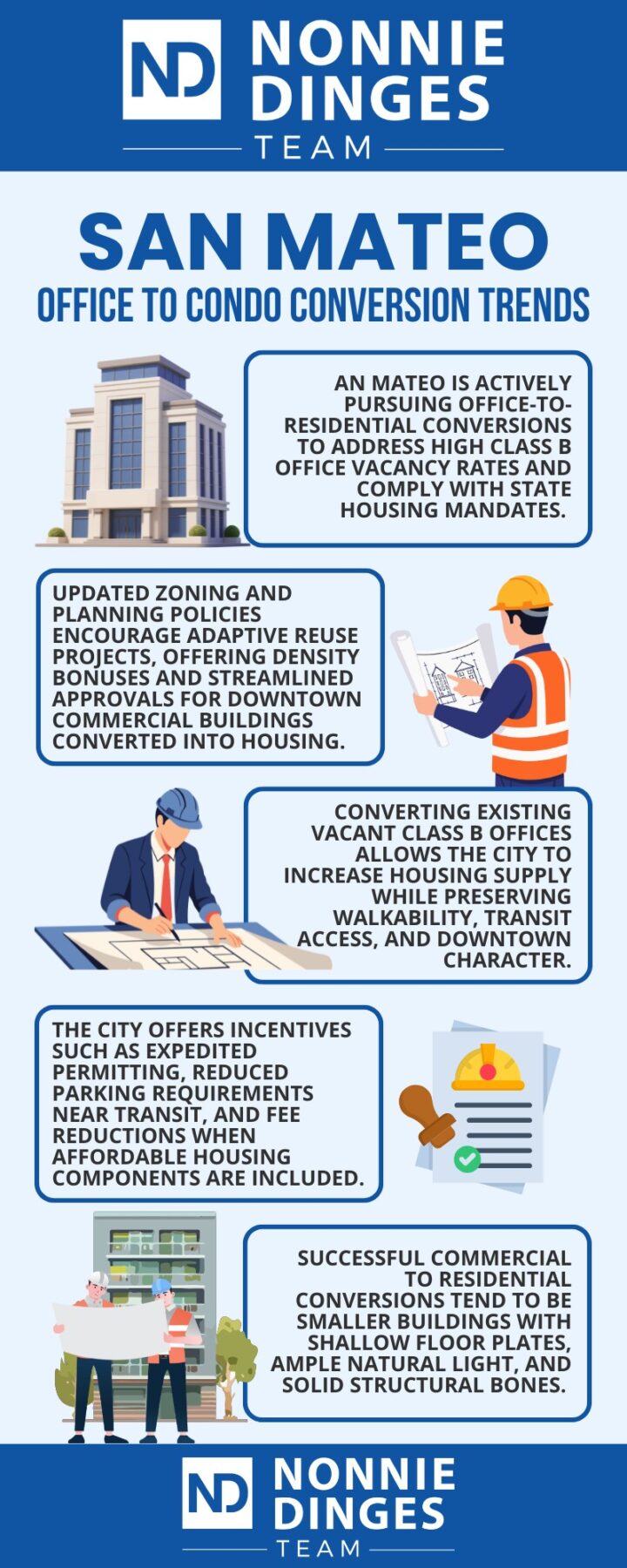
Yes. San Mateo is actively pursuing office-to-residential conversions to address high Class B office vacancy rates and comply with state housing mandates.
Updated zoning and planning policies now encourage adaptive reuse projects San Mateo-wide, offering density bonuses and streamlined approvals for downtown commercial buildings converted into housing.

Why Class B Office Vacancy Rates Are Driving Change
The Flight to Quality
Class B office space refers to older commercial buildings that lack modern amenities like advanced HVAC systems, flexible layouts, on-site services, and sustainability features found in newer Class A offices.
As companies downsize or relocate, these buildings are experiencing the highest vacancy rates.
Over the last few years, tenants have “flown to quality,” favoring newer, amenity-rich campuses or fully remote setups. That has left many well-located but outdated buildings struggling to attract long-term office tenants.
Inventory Pressure
Downtown San Mateo redevelopment zones now contain a surplus of empty or underperforming Class B offices.
From a planning standpoint, this creates a rare opportunity: add housing without expanding outward or rezoning stable residential neighborhoods.
Converting existing structures allows the city to increase housing supply while preserving walkability, transit access, and downtown character.
Incentives for Adaptive Reuse Projects in San Mateo
Zoning Incentives
San Mateo’s General Plan 2040 explicitly supports mixed-use redevelopment in key corridors.
For qualifying office-to-residential projects, the city offers incentives such as expedited permitting, reduced parking requirements near transit, and fee reductions when affordable housing components are included.
These mixed-use zoning incentives are designed to offset some of the financial friction developers face.
Streamlining the Process
Just as important as incentives is predictability. The city has worked to clarify entitlement pathways so developers aren’t stuck in years of uncertainty.
By reducing red tape and aligning zoning with housing goals, San Mateo makes adaptive reuse a more realistic alternative to demolition and full rebuilds.
The Reality of Commercial to Residential Retrofit Cost
Despite the momentum behind adaptive reuse, converting offices into homes is rarely a simple or inexpensive exercise.
The biggest hurdle developers face is not zoning or demand, but the hard construction realities of adapting buildings that were never meant for residential living.
In San Mateo, three cost categories consistently determine whether an office-to-residential conversion pencils out or stalls at the feasibility stage:
Plumbing retrofits
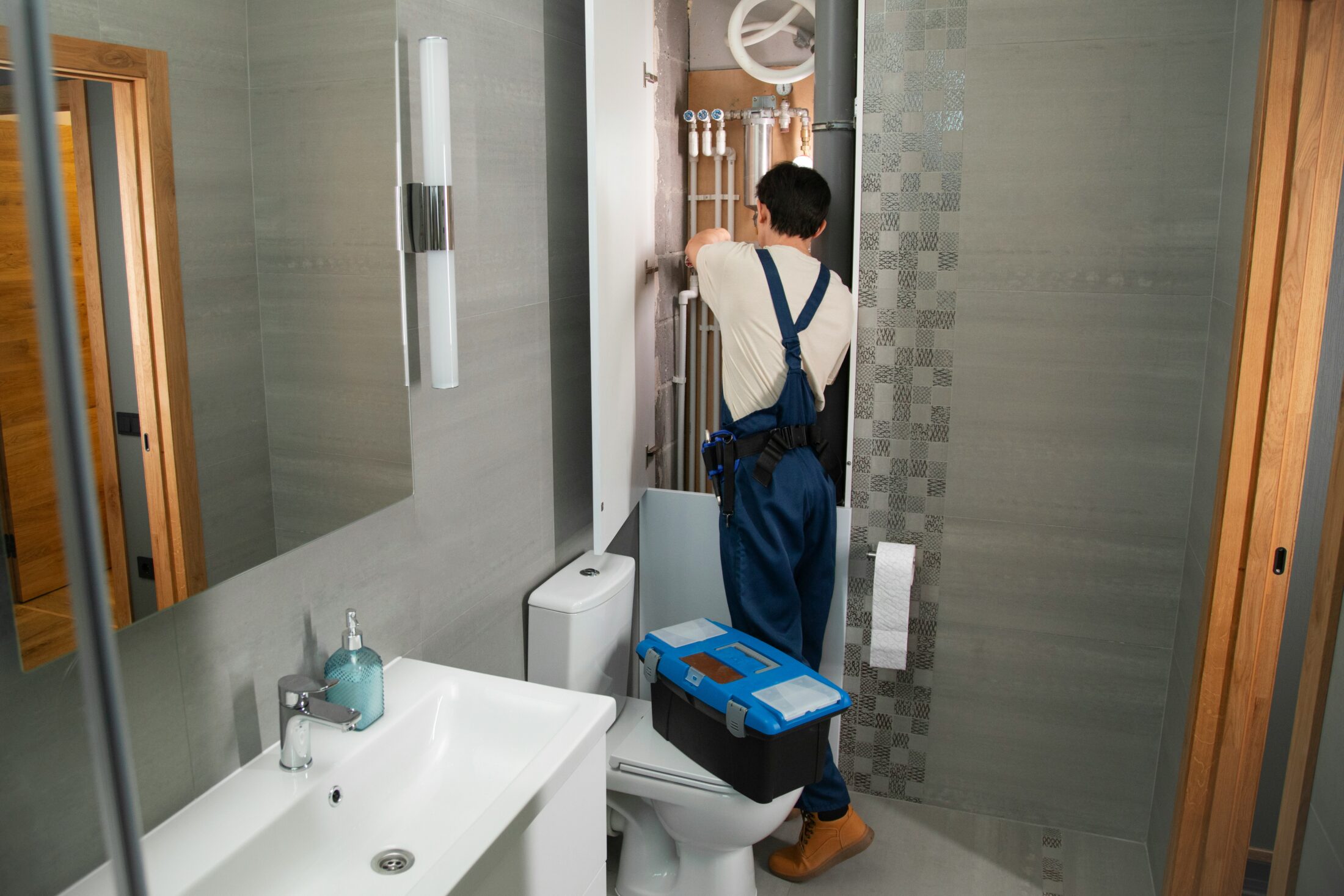
Most office buildings were designed with centralized restrooms and minimal water lines, not individual kitchens, laundry hookups, or multiple bathrooms per unit.
Converting these spaces requires cutting through concrete slabs to install new vertical plumbing stacks, rerouting waste lines floor by floor, and upgrading water pressure systems—work that is both labor-intensive and disruptive to the existing structure.
Window operability
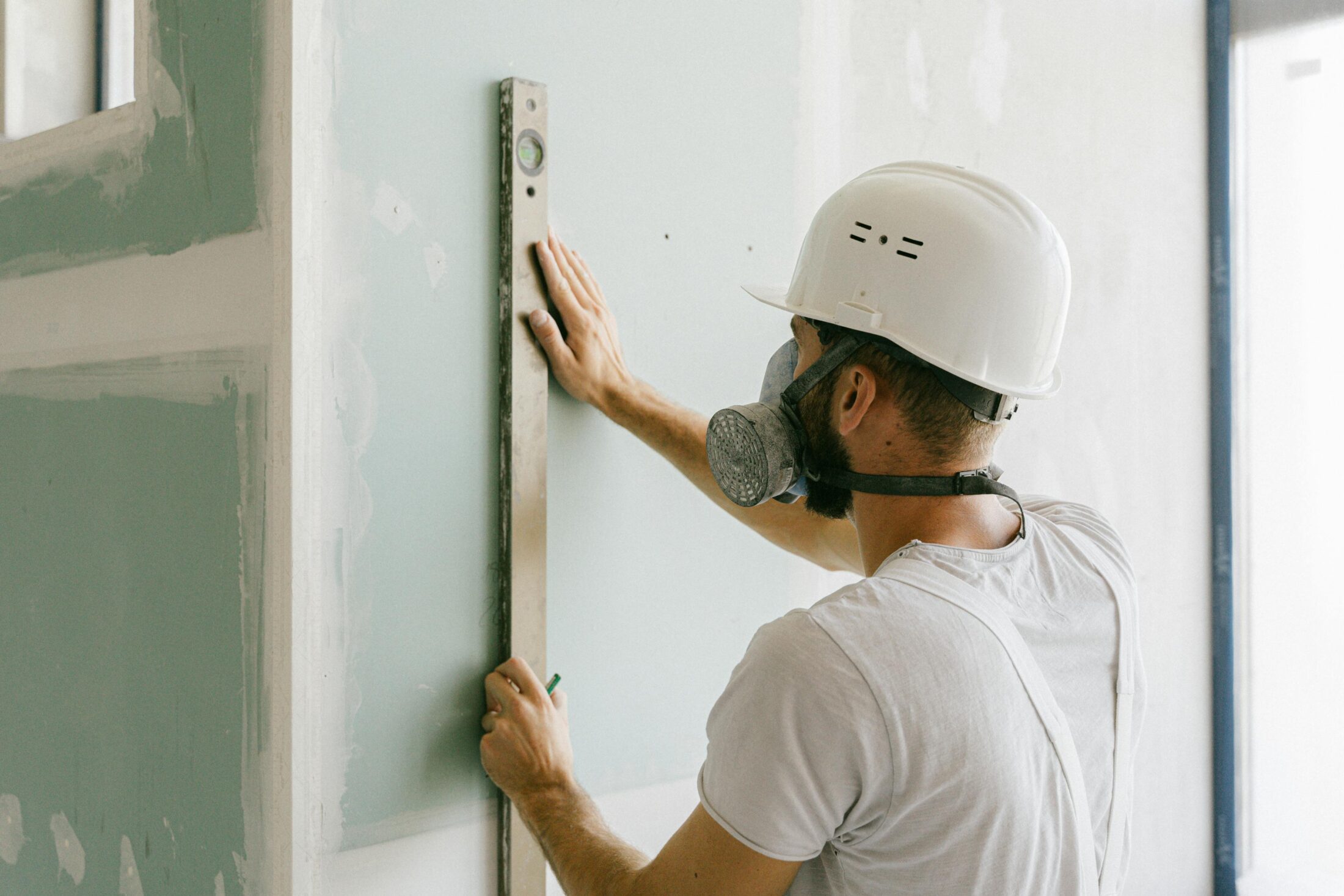
Residential building codes require operable windows for natural ventilation, light, and emergency egress. Many Class B office buildings use sealed curtain-wall systems that were never intended to open.
Retrofitting these façades often means replacing large portions of the exterior envelope, triggering significant material, engineering, and installation costs that can rival new construction.
Seismic upgrades
California’s seismic standards have evolved substantially over the last few decades. Older commercial buildings frequently fall short of current residential safety requirements, especially once a change of use is proposed.
Structural reinforcement—such as shear walls, foundation strengthening, or steel bracing—can become one of the largest line items in an office-to-residential conversion budget.
Feasibility Math
Here’s the hard truth seasoned developers will tell you: the commercial to residential retrofit cost can sometimes exceed new construction on a per-square-foot basis. That’s why not every empty office becomes housing.
Successful conversions tend to be smaller buildings with shallow floor plates, ample natural light, and solid structural bones. Deep, wide buildings with sealed curtain walls often just don’t pencil out.
Conversion Feasibility Comparison Table
| Building Attribute | Ideal Candidate for Condo Conversion | Poor Candidate (Demolition Likely) |
|---|---|---|
| Floor Plate Depth | Shallow (allows light to the center) | Deep (dark center spaces) |
| Window Structure | Operable / Easily Replaced | Sealed Curtain Wall |
| Location | Walkable Downtown Core | Isolated Office Park |
| Vacancy Duration | 2+ Years | < 6 Months |
Frequently Asked Questions
No. It doesn’t mandate conversions, but it strongly encourages them by aligning zoning and incentives with state housing requirements.
Adaptive reuse repurposes existing structures, while new construction involves demolition and rebuilding from the ground up.
Some projects may qualify for state or regional housing grants, especially those including affordable units, but availability varies by funding cycle.
Downtown San Mateo and areas near older transit-adjacent office corridors show the highest concentration.
From acquisition to completion, most projects take 24–36 months, depending on building condition and approvals.
Both. Some conversions are rental-focused, while others deliver for-sale condos, depending on market conditions.
They can. Older structures often have higher maintenance and insurance costs, which can translate into elevated HOA dues.
Key Takeaway
San Mateo office to residential conversion is not a silver bullet for the housing crisis, but it’s a smart, targeted tool for revitalizing Downtown San Mateo.
When the building fits and incentives align, these projects can balance high retrofit costs with long-term value—ultimately delivering distinctive, modern condos inside familiar commercial shells.
If you’re curious whether a specific building, investment, or neighborhood could benefit from San Mateo’s evolving conversion landscape—or if you’re considering buying into one of these unique properties—I’m always happy to talk it through.
You can reach me directly at 650-218-3353 or email dingesnonnie@gmail.com for straightforward, local insight from someone who’s been in the trenches of Peninsula real estate for years.